Exercise Snacks in a Heat Wave: What Changes and What Does Not
Quick Answer: Exercise snacks — short bursts of movement spread through the day — hold up better in heat than any longer format, because they end before heat accumulates. Two things change: do them indoors or in shade, and watch total daily heat load rather than individual session intensity. Everything else stays the same, which is exactly why they are the right format for a heat wave.
Every form of exercise gets harder in a heat wave except this one.
The reason is structural, and it makes late summer the best possible argument for the exercise snack approach.
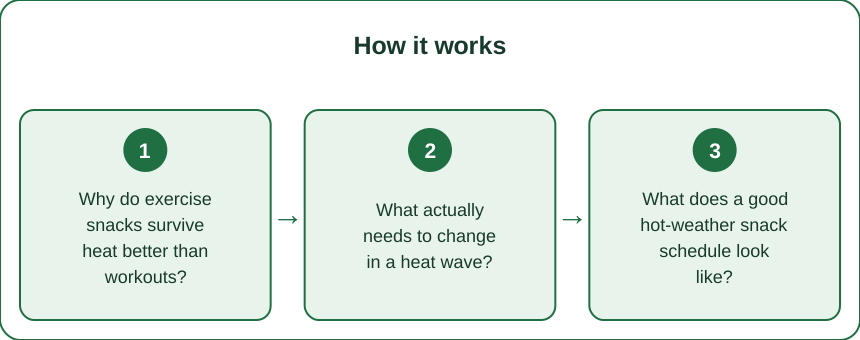
Why do exercise snacks survive heat better than workouts?
Because heat problems are largely a function of duration, and exercise snacks eliminate duration by design.
Heat accumulates over time during exercise. Your body produces heat faster than it can shed it, core temperature rises gradually, and the physiological cost climbs as the session goes on. Most of the discomfort and all of the risk in hot-weather exercise comes from that accumulation. A 60-minute run in heat is far more than twice as demanding as a 30-minute one.
An exercise snack ends before accumulation begins. A set of 20 bodyweight squats, a minute of stair climbing, or 30 seconds of jumping — these finish in under two minutes. Core temperature barely moves, and you return to a cool environment immediately afterward.
Recovery happens between snacks, in air conditioning. This is the part that makes the approach genuinely heat-resilient. You get the training stimulus and then spend the next hour cooling in a comfortable environment before the next one.
Sweat management is trivial, which removes the other practical barrier to summer exercise. A two-minute burst does not require a shower or a change of clothes, which is why people keep doing them in August when their gym sessions have stopped.
The research context: short, frequent bouts of vigorous activity spread through the day produce meaningful cardiometabolic benefits, and studies on brief stair-climbing and bodyweight bouts have found improvements in fitness markers from remarkably small total volumes. The format was never a compromise — it is a legitimate approach that happens to also be the one heat cannot easily disrupt.
What actually needs to change in a heat wave?
Two things, and they are both about environment rather than about the exercise itself.
1. Move them indoors, or into genuine shade.
This is the main adjustment. A set of squats in an air-conditioned office is identical to a set of squats in March. A set of squats in a 95°F parking lot is a different activity with a different cost.
Indoor options that work anywhere: bodyweight squats, wall sits, calf raises, desk or wall push-ups, stair climbing, marching in place, glute bridges, and standing hip hinges. Stairs are the highest-value option — vigorous, requires nothing, and the stairwell is usually cooler than the office.
2. Watch total daily heat load, not individual sessions.
Even though each snack is trivially short, eight of them across a hot day still add up, particularly if you are also commuting, running errands, and generally living in a heat wave. The individual session risk is near zero; the cumulative fluid and thermal cost is not.
The practical version: drink more than usual, and if you are doing snacks outdoors or in a hot building, reduce the number rather than the intensity of each.
What does not need to change:
- Intensity. These are short enough that hard is still fine.
- Frequency, if you are indoors.
- The exercises themselves.
- Your progression. Add reps or difficulty on the same schedule as any other time of year.
What does a good hot-weather snack schedule look like?
Structure matters more than the exercises, because the failure mode is forgetting rather than being unable.
A workable daily pattern:
- On waking: 20 bodyweight squats. Takes 40 seconds, and it establishes the day.
- Mid-morning: one flight of stairs, briskly, twice.
- Before lunch: 10 to 15 push-ups at whatever level you can do with good form — wall, incline, or floor.
- Mid-afternoon: 30 seconds of marching in place or 20 calf raises, which doubles as a break from sitting.
- Late afternoon: stairs again, or a set of glute bridges.
- Evening: whatever you have energy for.
That is roughly six minutes of total movement across a day, and it meaningfully exceeds what most people do in a heat wave when their normal routine has collapsed.
The scheduling problem is the real problem. Exercise snacks fail not because they are hard but because they are easy to forget — there is no gym bag, no class time, no cue. Attach each one to something that already happens: the coffee machine, a specific meeting ending, a bathroom trip, the kettle boiling. Habit stacking is the whole technology here.
A phone timer works but performs worse than an existing cue, because it is easy to dismiss and it arrives at inconvenient moments. Anchoring to an existing routine survives better.
Two weeks of consistency is what builds the pattern. After that the cues do the work and it stops requiring decisions.

Myth vs Fact: Exercise Snacks
Myth: Short bursts are not long enough to count. Fact: Brief vigorous bouts spread across a day produce real cardiometabolic benefits, and research on short stair-climbing and bodyweight protocols has found meaningful fitness improvements from very small total volumes. They are not a full substitute for structured training, and they are considerably more than nothing.
Myth: You need to warm up first. Fact: For bodyweight movements at moderate intensity, the first few reps are the warm-up. For genuinely maximal efforts or if you have a joint issue, start easier for the first set of the day.
Myth: They only help if you do a lot of them. Fact: Even a small number consistently is better than a larger number occasionally. Consistency is the mechanism, and it is also what heat threatens most.
Myth: They replace structured exercise. Fact: They are excellent at interrupting sedentary time and at maintaining a baseline, and they are not a complete substitute for progressive strength training or sustained aerobic work. In a heat wave, they are a better maintenance tool than a cancelled gym session.
Myth: You will get too sweaty to work. Fact: Two minutes of movement in an air-conditioned space does not produce meaningful sweating for most people. If it does, reduce the intensity slightly or move to a cooler spot — not to a longer session.
Myth: Exercise snacks are only useful for beginners. Fact: They are useful for anyone whose day is largely sedentary, regardless of training level. A well-trained person who sits for nine hours still benefits from interrupting that, and the benefit of breaking up sitting appears to be somewhat separate from the benefit of exercising.
How do you use this stretch to build a habit that survives fall?
This is the most valuable framing available, and almost nobody uses it.
A heat wave is a habit-building opportunity precisely because your normal routine is disrupted. Habits form more easily when existing patterns are already broken — the competing routine is not there to override. If your usual training has stopped for the heat, the space is available.
Build the cues now, while the alternative is unappealing. Attaching squats to the coffee machine in August, when a run outside is genuinely unpleasant, is far easier than trying to add them in October when your training is back to normal and the slot feels redundant.
Then keep them when the weather turns. Exercise snacks and structured training are complementary, not competing. The snacks interrupt sedentary time; the training builds fitness. People who maintain both do better than people who do either.
What to expect over eight weeks: noticeably easier stairs, better tolerance for standing and walking, and — for people coming from a fully sedentary baseline — measurable fitness improvement. It is not the same trajectory as structured training, and it is a real trajectory.
One honest caveat: if you have a cardiovascular condition, joint problems, or have been inactive for a long time, brief high-intensity bursts still warrant a conversation with a clinician first. “Short” does not mean “low intensity,” and a hard 30-second effort is a genuine cardiovascular demand. Start at moderate intensity and build. This is general information, not medical advice.
And in heat specifically: stop if you feel dizzy, get chills, feel nauseated, or notice a headache arriving. Those apply to two-minute efforts in a hot building just as they do to long outdoor sessions.
FAQ: Exercise Snacks in Heat, Answered
How many exercise snacks per day is enough?
There is no established number. Four to eight brief bouts across a day is a practical range that most people can sustain, and even three consistently is meaningfully better than none.
Can I do them outdoors in a heat wave?
Yes, in shade and with fewer of them. But indoors is easier, more consistent, and removes the main variable, so there is little reason to insist on outdoors during a heat wave.
Do I need to change clothes?
No, and that is much of the point. Two minutes of moderate movement in air conditioning does not produce meaningful sweat. If it does, ease the intensity slightly.
What is the single best exercise snack?
Stairs, if you have them. They are vigorous, need no equipment, involve a large muscle mass, and the stairwell is usually cooler than wherever you are working.
Will these keep my fitness up if I cannot train in the heat?
They will maintain a baseline and interrupt sedentary time well. They will not fully replace progressive strength or endurance training, so expect some loss over a long stretch — less than you would lose doing nothing.
TL;DR: Exercise snacks are the most heat-resilient exercise format there is.
- Heat problems come from duration, and a two-minute burst ends before heat accumulates.
- Recovery happens in air conditioning between snacks, which is what makes the format work in a heat wave.
- Only two things change: go indoors or into shade, and watch total daily heat load rather than individual session intensity.
- Intensity, frequency, and progression all stay the same.
- Stairs are the best single option — vigorous, free, and the stairwell is usually cool.
- Anchor each one to an existing routine cue, not a timer. Forgetting is the failure mode, not difficulty.
- Build the habit now while your normal routine is disrupted, and keep it when the weather turns.
Pick one cue today — the kettle, the coffee machine, the end of a meeting — and attach 20 squats to it.
Keep Reading
This article is for general informational purposes only and is not medical advice. Always consult a qualified health professional for guidance specific to you.