Why Exercise Snacks Feel Harder in the Morning Than the Afternoon
Quick Answer: Morning exercise snacks feel harder for three measurable reasons: body temperature is at its daily low (roughly one degree cooler than late afternoon, which reduces muscle compliance and power output), spinal discs are maximally hydrated after lying down, which stiffens the back and reduces bend, and your nervous system has not fully switched on in the first hour or two after waking. None of this means morning snacks are less effective - the health benefits are similar - it means the morning version should be lower-intensity and longer-ramping, and the harder ones belong in the afternoon.
You do ten squats by the kettle at 7:30 and it feels like a genuine effort. You do the identical ten at 3pm and barely notice them.
Nothing about your fitness changed in seven hours. What changed is that almost every physical system that contributes to easy movement runs on a daily rhythm, and 7:30am is close to the bottom of most of them.
This is useful rather than discouraging, because it tells you what to put where.

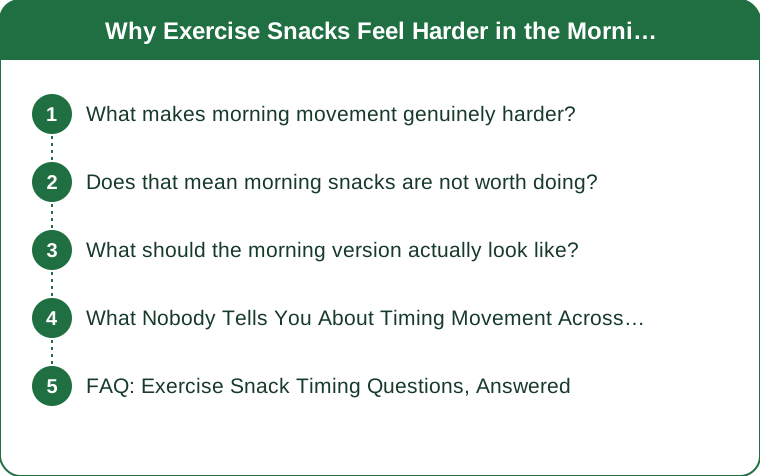
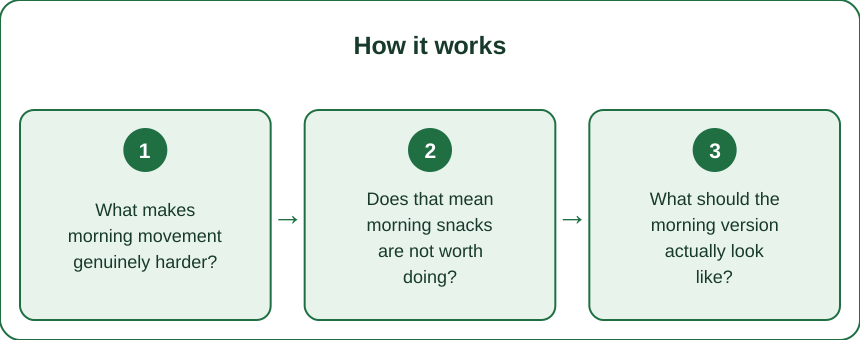
What makes morning movement genuinely harder?
Three things, and they are all measurable rather than psychological.
Core body temperature is at its daily minimum in the early morning. It bottoms out roughly one to two hours before you naturally wake and peaks in the late afternoon or early evening. The swing is around 0.5 to 1°C, which sounds trivial and is not. Warmer muscle is more compliant, contracts faster, and produces more power. This is the single largest contributor, and it is also why sports performance records skew heavily toward late-afternoon competition.
Your spinal discs are at maximum hydration. Overnight, without gravity compressing the spine, the intervertebral discs absorb fluid and swell. You are genuinely taller in the morning - typically by one to two centimetres. The consequence is a stiffer, less mobile spine for the first hour or so, which is why bending to touch your toes at 7am is a completely different experience from doing it at 5pm.
This has a practical safety implication: loaded spinal flexion - a heavy bent-over movement, a deep loaded forward fold - is best avoided in the first hour after waking. Not dangerous exactly, but the discs are under more internal pressure than they will be later.
Nervous system activation lags. Sleep inertia - the grogginess after waking - affects reaction time, coordination and perceived effort for anywhere from fifteen minutes to over an hour, and longer if you were woken abruptly or slept badly. During that window, the same physical work requires more perceived effort because the signal from brain to muscle is simply less crisp.
And a fourth, smaller factor: you are mildly dehydrated after seven or eight hours without fluid, which raises perceived effort a little on its own.
Does that mean morning snacks are not worth doing?
No - and this is the important part, because the conclusion people draw is the wrong one.
The research on exercise snacks - short bouts of movement scattered across the day - shows benefits for glucose handling, blood pressure, and cardiorespiratory fitness that are not especially sensitive to time of day. Morning snacks work. They just feel worse per unit of work.
Several things actually favour the morning:
Adherence is better. Movement done early is movement that cannot be displaced by the rest of the day. The 8am set happens; the 4pm set gets negotiated with a meeting.
The metabolic effect on the day ahead. Movement before or shortly after breakfast improves glucose handling for the meal that follows, and breakfast is the meal most people eat in the most sedentary state.
It breaks the longest sedentary block for many people. The stretch from waking to mid-morning is often the most continuously seated part of a desk worker’s day - commute, then desk.
And light exposure, if you can do it near a window or outside. Morning light is the strongest signal for anchoring the daily rhythm, which becomes more valuable as sunrise moves later through September and October.
The correct adjustment is intensity, not existence. A morning snack should be lower-intensity, longer-ramping, and biased toward movements that do not demand a mobile spine or maximal power. The afternoon is where the hard ones go.

What should the morning version actually look like?
Build it around gradual, joint-friendly movement rather than power.
Ramp rather than start. Where an afternoon snack can begin at full effort, a morning one benefits from thirty seconds of easy movement first - marching on the spot, arm circles, a few slow half-squats. This is not a formal warm-up, it is a runway.
Good morning options:
- Bodyweight squats, controlled tempo - no spinal flexion, easy to scale, warms the largest muscle mass quickly
- Wall or counter push-ups - upper body without loading a cold shoulder at a bad angle
- Marching or stair climbing - the most reliable way to raise temperature with essentially no technical demand
- Standing hip hinges without load - opens the posterior chain without the disc pressure of a loaded bend
- Calf raises - genuinely useful, nearly effortless, and one of the better circulation prompts after a night lying down
Less good in the first hour:
- Deep loaded forward folds or heavy bent-over work - the disc hydration point
- Explosive jumping - cold, stiff tendons and reduced compliance make this the least favourable time for it
- Anything requiring maximal range - you do not have it yet and forcing it is where morning strains come from
- Maximal effort intervals - you will underperform relative to the same effort later and it will feel disproportionately unpleasant
Save those for after 2pm, where temperature is high, the spine has decompressed under normal daily loading, and the nervous system is fully online. If you only have the capacity for one genuinely hard snack in the day, the mid-to-late afternoon is where it produces the most work for the least perceived effort.
What Nobody Tells You About Timing Movement Across the Day
The afternoon dip is a good time for movement, not a bad one. The mid-afternoon energy trough - roughly 1pm to 4pm - is a real circadian phenomenon and it is one of the most productive moments for a movement snack. Two minutes of activity does more for that dip than a coffee does, and unlike the coffee it does not affect your sleep.
Perceived effort at a fixed workload varies by up to 10 to 15 percent across the day. So a set that feels moderate in the morning and easy in the afternoon may be genuinely identical work. If you track anything, track the work rather than how it felt.
Evening people and morning people have shifted curves, not different rules. A genuine evening chronotype’s temperature minimum arrives later, which means their 8am is physiologically closer to someone else’s 6am. If mornings feel unusually brutal to you, this is a plausible explanation and it is not a character defect.
The morning stiffness resolves faster with movement than with time. Waiting an hour helps a bit. Moving for two minutes helps considerably more, because the temperature rise is driven by muscular activity, not by the clock.
Late-evening high-intensity snacks can cost you sleep. Intense movement within about an hour of bed raises core temperature and sympathetic activity at exactly the point where both should be falling. Gentle movement is fine and often helpful; hard intervals at 10pm are a recognised sleep disruptor.
And the seasonal one that is starting to bite right now: as sunrise moves later through September, the morning gets colder and darker, and both make early movement feel harder than it did in July. This is not a decline in discipline. If your morning snack has quietly stopped happening in the last two weeks, the sunrise time is a more likely explanation than your motivation.
FAQ: Exercise Snack Timing Questions, Answered
Should I move my snacks to the afternoon then?
Not all of them. Keep the morning ones because they are the most reliable to actually complete - just make them lower-intensity and give them a thirty second ramp. Put the one hard snack of your day in the mid-to-late afternoon where you will get more work out of the same effort. The best pattern for most people is easy in the morning, hard mid-afternoon, gentle in the evening.
How long after waking before it stops feeling hard?
The nervous system component largely clears within fifteen to sixty minutes. Spinal stiffness eases substantially in the first hour of being upright and moving. Body temperature climbs across the whole morning and does not peak until late afternoon, so some difference remains all day. Practically, most people find things feel notably better after about an hour of being up and moving normally.
Is it bad to exercise before eating in the morning?
For a two-minute snack, no - fasted movement of that duration is well tolerated and there is some evidence it improves glucose handling for the meal that follows. It is a different question for a long or intense session, where fuelling matters. If you feel lightheaded, that is a signal to eat something first rather than something to push through.
General information, not medical advice. If you have a diagnosed cardiac, metabolic or spinal condition, check with a clinician about timing and intensity.
TL;DR:
- Morning movement is harder because core temperature is at its daily low, spinal discs are maximally hydrated and stiff, and the nervous system is still switching on.
- Morning snacks still work - the benefits hold. Adjust intensity, not existence.
- Morning: squats, counter push-ups, stairs, calf raises, with a thirty second ramp. Avoid loaded spinal flexion and jumping in the first hour.
- Put the hard snack in the mid-to-late afternoon - same effort, more work.
- If your morning snack has quietly stopped in the last fortnight, check the sunrise time before blaming yourself.
The morning set is not harder because you are worse at it. It is harder because you are a degree colder and a centimetre taller than you will be by lunchtime.
Keep Reading
This article is for general informational purposes only and is not medical advice. Always consult a qualified health professional for guidance specific to you.