Exercise Snacks When Your Knees or Wrists Cannot Take Impact
Quick Answer: Exercise snacks work through muscle contraction and circulation, not through impact — so jumping is optional. Slow calf raises, wall sits, sit-to-stands and isometric holds all produce the glucose-clearing and circulation effects the research is built on, with zero joint loading. Aim for two minutes of continuous muscle engagement; the tissue does not know whether you got there by jumping or by holding.
Most exercise snack lists open with jumping jacks and stair sprints, which is unhelpful if your knees object to stairs or your wrists cannot take a plank.
The good news is that the mechanism the research actually describes has nothing to do with impact. It is about large muscles contracting frequently enough to keep glucose moving and blood circulating. There are plenty of ways to do that without a single hard landing.

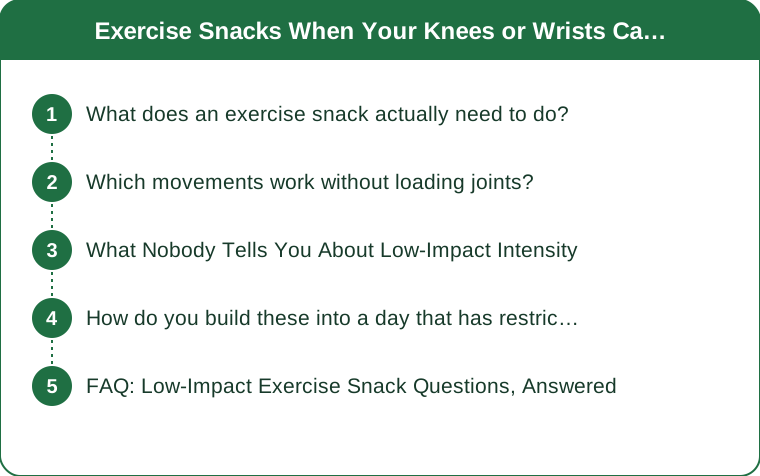
What does an exercise snack actually need to do?
Recruit a meaningful amount of muscle, for long enough, often enough. Impact is not on the list.
The research on breaking up sedentary time centres on two mechanisms. The first is glucose uptake: contracting muscle pulls glucose from the blood through a pathway that does not require insulin, which is why even brief, light activity blunts a post-meal blood sugar rise. The second is circulatory: sitting still reduces blood flow through the legs, and muscle contraction restores it.
Both mechanisms respond to contraction, not to force through a joint. A slow calf raise and a jump both contract the calf. One of them costs your knees nothing.
The dose that shows up in studies is smaller than most people expect. Interventions demonstrating meaningful glucose effects have used as little as two to three minutes of light activity every 30 to 60 minutes, and some have used simple calf raises performed while seated, which is about as low-impact as movement gets.
Muscle mass recruited matters more than intensity. The quadriceps, glutes and calves are the largest glucose sinks in the body. A movement that uses them gently outperforms a harder movement that only uses the arms.
Frequency beats duration. Six two-minute breaks spread across a day do more for glucose regulation than one twelve-minute block, because the effect is about interrupting sitting rather than accumulating volume.
So the design brief is: large muscles, two minutes, several times a day, whatever mode your joints accept.
Which movements work without loading joints?
A short menu, organised by what they demand, so you can pick around whichever restriction you have.
Knee-friendly, standing: Calf raises — slow, 3 seconds up, 3 seconds down, 15 to 20 reps. Almost no knee involvement and a large muscle group. Hip hinges to a light range — hands on hips, hinge back until you feel the hamstrings, return. Loads the hip rather than the knee. Standing hip abduction — leg out to the side against light resistance or none, 15 per side. Marching in place, keeping the foot low. Contraction without landing force.
Wrist-friendly, floor or seated: Glute bridges — lying, feet flat, lift and hold. No wrist loading at all and heavily glute-dominant. Seated leg extensions — straighten the knee against gravity, hold two seconds. Fine for most knees because the load is body-segment weight only. Dead bugs with hands free. Core work with no wrist pressure. Wall sits at a shallow angle — the depth is adjustable to whatever your knee tolerates, and a 20 second hold is plenty.
Both-restricted, minimal equipment: Isometric holds against a wall or doorframe. Push into an immovable surface at moderate effort for 10 to 20 seconds. Real contraction, zero joint movement. Sit-to-stands from a higher chair, which reduces knee range substantially. If a standard chair is too much, add a cushion. Heel and toe rocks, slow and controlled.
The one that surprises people: simply standing up and walking to another room and back at normal pace clears most of the benefit for a two-minute break. It is not a compromise version. It is the version most of the research used.

What Nobody Tells You About Low-Impact Intensity
Slow is not easy, and this is where most people undershoot.
The common assumption is that removing impact removes intensity, so low-impact snacks must be a weaker version. In practice the opposite problem shows up: people perform low-impact movements too quickly and too casually, and get very little contraction out of them.
Tempo is the intensity dial. A calf raise done in one second up and one second down is a bounce, and the tendon does most of the work. The same movement at three seconds up, one second pause, three seconds down is genuinely difficult by rep twelve, and the muscle does all of it. Nothing about the joint loading changed.
Isometrics are underrated for exactly this reason. Holding a position at moderate effort produces sustained contraction with no movement at all. A 30 second wall sit at a comfortable depth is real work. Pushing your palms together hard for 15 seconds engages the chest and arms with no wrist extension.
Range of motion is the other dial. A partial-range movement within a pain-free zone, done slowly, is far more useful than a full-range movement you have to rush or brace through.
The honest calibration: if you can hold a conversation completely normally and feel nothing at the end of two minutes, the snack did very little. You are looking for a mild, warm working sensation in the muscle — not breathlessness, not joint sensation, just evidence that something contracted.
And the thing to avoid: compensating for lost impact by adding load. If knees are the restriction, adding weight to a squat is the wrong direction. Slow the movement down instead.
How do you build these into a day that has restrictions?
Attach them to things that already happen, and keep the barrier under ten seconds.
Anchor to existing triggers rather than a timer. The kettle boiling, the end of a call, standing up from a meal, waiting for a file to load. A timer creates a decision every hour; an anchor removes the decision entirely. This matters more for people managing a joint condition, because on a bad day a decision is much easier to skip than a habit.
Scale by day, not by rule. The realistic version has three tiers. On a good day, the full two minutes. On an ordinary day, one minute. On a flare day, stand up and shift weight for thirty seconds. A tiered plan survives; an all-or-nothing plan does not.
Keep at least one option seated. Some days standing repeatedly is the problem. Seated calf raises, seated leg extensions and isometric pushes cover a whole day without getting up if needed, and still deliver most of the glucose benefit.
Post-meal is the highest-value slot. If you only do one, put it 15 to 30 minutes after the largest meal, when blood glucose is rising. Two minutes there does more than two minutes at any other point in the day.
Track adherence, not performance. A tally of how many breaks happened is more useful than reps or time, and it avoids the trap of measuring progress by a number that a flare will push backwards.
Seasonal note: as the weather cools and joints stiffen more in the morning, the first snack of the day is worth moving later or making gentler. Cold tissue tolerates less range, and the movement that felt fine in August can feel different in a cold room in October. That is normal, and it is a reason to adjust the movement rather than skip it.
This is general information, not medical advice. If a joint condition is being actively managed, run the movement list past your physiotherapist or doctor — they will usually adjust two things and approve the rest.
FAQ: Low-Impact Exercise Snack Questions, Answered
Do these really work as well as the jumping versions?
For the metabolic and circulatory effects, yes — those depend on contraction and are well demonstrated with light activity. For bone density and power, no, impact does contribute something specific that these do not replace. Exercise snacks were never the tool for those anyway.
How many should I aim for in a day?
Start with three and build to five or six. The research pattern is roughly one break per hour of sitting. Three consistently beats six attempted and abandoned.
Will two minutes really affect my blood sugar?
Studies breaking up sitting with brief light activity have shown meaningful reductions in post-meal glucose spikes, and some used movements as simple as seated calf raises. The effect is modest per break and adds up across a day.
My knees hurt on some days and not others. Should I push through?
No. Switch modes rather than pushing. Isometrics and seated options exist for exactly those days, and using them keeps the habit alive without provoking anything. Sharp pain, swelling or a joint that gives way is a stop-and-get-it-checked signal, not a scale-down signal.
Can I do these with a wrist injury and no floor work at all?
Easily. Everything in the standing list — calf raises, hip hinges, marching, sit-to-stands, wall sits — involves no wrist loading whatsoever. A full programme exists without ever putting a hand on the floor.
Do resistance bands help?
They are useful for adding intensity without impact or joint compression, especially for hips and shoulders. A light band is around $10 and expands the menu considerably. Keep one at the desk rather than in a drawer.
TL;DR:
- Exercise snacks work through muscle contraction and circulation — impact is optional.
- Calf raises, sit-to-stands, wall sits, glute bridges and isometric holds cover every common restriction.
- Slow tempo is the intensity dial: 3 seconds up, 3 down beats bouncing every time.
- Anchor to existing triggers, keep a seated option, and put one break 15 to 30 minutes after the biggest meal.
- Have a good-day, ordinary-day and flare-day version so the habit survives bad weeks.
If every exercise snack list you have read starts with jumping jacks, you were reading the wrong list, not facing the wrong body.
Keep Reading
This article is for general informational purposes only and is not medical advice. Always consult a qualified health professional for guidance specific to you.