When Exercise Snacks Don't Actually Work for You (and What to Do Instead)
Quick Answer: Exercise snacks (short 2-5 minute movement bursts throughout the day) tend to underperform for people who need structured, longer sessions to feel mentally ‘done’ with exercise, or for goals requiring sustained cardiovascular load — they’re most effective as a supplement to, not full replacement for, longer structured workouts.
Exercise snacks got popular as a low-barrier fitness solution, and for a lot of people they genuinely work. But treating them as a universal replacement for real workouts sets some people up for disappointment.

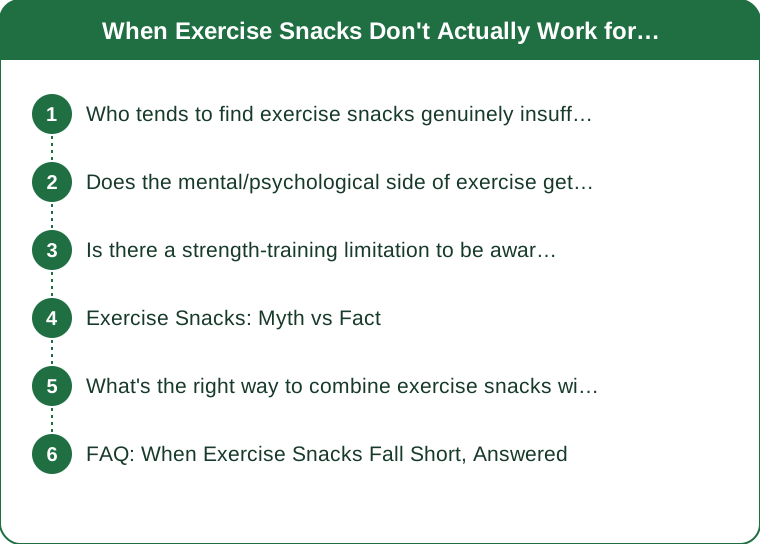
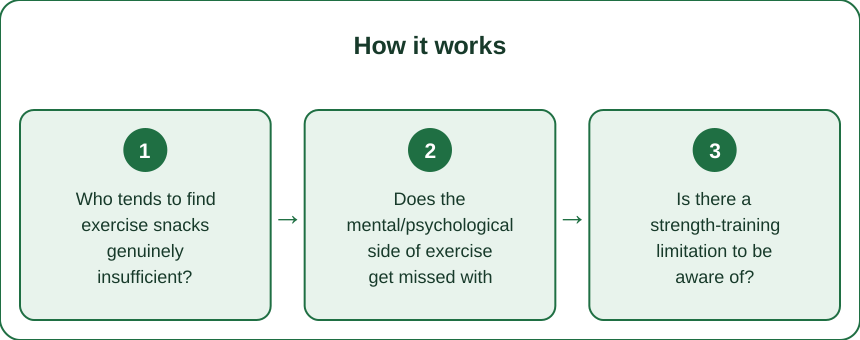
Who tends to find exercise snacks genuinely insufficient?
People training for specific endurance or cardiovascular goals — like building running capacity or improving VO2 max — generally need sustained effort over 20+ continuous minutes that short bursts can’t replicate, since cardiovascular adaptation depends heavily on sustained elevated heart rate, not just cumulative minutes of movement. Exercise snacks maintain general activity but don’t substitute for structured cardio training in this specific case.
Does the mental/psychological side of exercise get missed with snacking?
For many people, yes — a dedicated workout session provides a mental structure and sense of completion that scattered short bursts throughout the day don’t replicate. If part of your motivation for exercising is stress relief or a mental reset, short exercise snacks may not deliver the same psychological benefit as a focused 30-45 minute session, even if the physical activity totals are similar.
Is there a strength-training limitation to be aware of?
Yes — meaningful strength gains generally require progressive overload with adequate volume per session, and very short bursts throughout the day often can’t accumulate enough working sets with proper rest between them to drive real strength adaptation. Exercise snacks work well for general movement and light activation, but dedicated strength training sessions remain necessary for building muscle or significant strength.

Exercise Snacks: Myth vs Fact
Myth: Exercise snacks can fully replace structured workouts for any fitness goal. Fact: They’re highly effective for general activity and metabolic health, but insufficient alone for specific endurance or strength-building goals.
Myth: If exercise snacks aren’t working for you, you’re doing them wrong. Fact: For some goals, the format itself is a mismatch, not a matter of execution.
What’s the right way to combine exercise snacks with structured workouts?
Treating exercise snacks as additive to, not a substitute for, your primary training tends to work best — use them to reduce sedentary time between structured sessions, rather than expecting them to replace strength or cardio-specific training entirely. This combination approach captures the general health benefits of frequent movement while still meeting more specific fitness goals.
FAQ: When Exercise Snacks Fall Short, Answered
Do exercise snacks still count toward general health guidelines?
Yes — they contribute meaningfully to weekly activity minutes and metabolic health, even if they don’t replace goal-specific training.
Is it a waste of time to do exercise snacks if you also do structured workouts?
Not at all — they help offset sedentary time between sessions and support overall activity levels beyond structured workout time alone.
How do you know if exercise snacks alone are enough for your goals?
If your goal is general activity and health, they’re likely sufficient; if your goal is specific strength or endurance improvement, structured sessions are still necessary alongside them.
TL;DR:
- Exercise snacks fall short for sustained cardio or specific endurance goals
- The mental ‘completion’ benefit of a full workout doesn’t fully transfer to short bursts
- Meaningful strength gains still require structured sessions with adequate volume
- Best used as an addition to structured training, not a full replacement
If exercise snacks haven’t been working for you, it’s likely a goal mismatch, not a failure on your part — pair them with structured sessions for the goals they can’t cover alone.
Keep Reading
This article is for general informational purposes only and is not medical advice. Always consult a qualified health professional for guidance specific to you.