Your Staircase Is a Gym: The Case for Stair-Based Exercise Snacks
Quick Answer: Stair climbing is the rare exercise snack with direct research behind it: studies on brief, vigorous stair bouts - around 20 to 60 seconds, repeated a few times a day - show measurable cardiorespiratory fitness gains within six to eight weeks. A staircase forces intensity a flat hallway cannot, works your biggest muscles through a real range, and lives inside your house, which deletes every excuse involving weather, equipment, or time. Three brisk climbs a day is a legitimate training floor, not a consolation prize.
People buy steppers, mini-bikes, and folding treadmills to do intervals at home, then walk past a full flight of stairs eleven times a day on the way to the equipment. The staircase was always the machine. It just never had a screen, so nobody counted it.

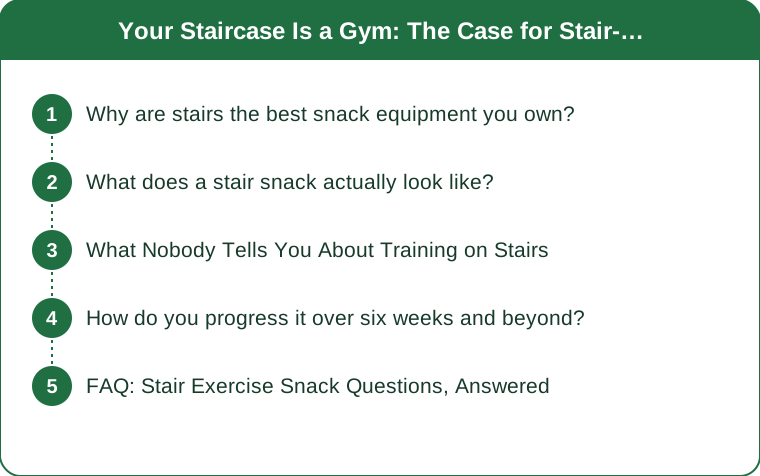
Why are stairs the best snack equipment you own?
Four reasons, one of them backed by unusually direct evidence.
The research was literally done on stairs. The exercise-snacks studies that made the concept famous used stair climbing as the intervention - short, vigorous bouts of roughly 20 seconds to a minute, three times a day, in otherwise sedentary adults. Result: meaningful improvements in cardiorespiratory fitness inside six weeks. Related work on brief vigorous everyday movement - the stuff of stair sprints and fast hill walks - associates a few one-to-two-minute bouts a day with substantially better long-term health outcomes. Most home equipment cannot cite anything this specific.
Stairs force intensity honestly. Lifting your entire body weight vertically is expensive - climbing costs several times the energy of flat walking at the same perceived pace. You cannot phone in a stair climb the way you can drift on a flat walk; gravity keeps score. That built-in intensity floor is exactly what makes a 60-second bout worth anything.
They train the muscles that age fastest. Every step is a single-leg press: glutes, quads, calves, and the balance system coordinating them. Stair capacity is one of the abilities people miss most when it fades, and the training for it is the thing itself.
And the friction is zero. No setup, no weather, no drive, no changing clothes - the commute to this gym is the hallway. For habit formation, that matters more than any feature of any machine, because the snack that requires nothing is the snack that happens on the tired days too.
What does a stair snack actually look like?
Pick by fitness level and knee history. All of these fit inside two minutes.
The base snack: the brisk climb. Climb one flight quickly - quick enough that your breathing changes by the top - walk back down at normal pace, repeat until 45 to 90 seconds have passed. That is the entire protocol from the studies. Two to four of these bouts spread across a day is the evidence-backed dose.
The strength flavor: step-ups on the bottom step. Ten controlled step-ups per leg, full foot on the step, pushing through the heel, standing tall at the top. Slower is harder. This turns the staircase into a leg day in miniature and needs only one step.
The calf-and-balance flavor: stand on the bottom step, heels hanging off, and do 15 slow calf raises with a fingertip on the rail. Sneaky-hard, genuinely useful for anyone who walks, runs, or hikes.
The upper-body cameo: incline push-ups. Hands on the third or fourth step, body in a line, 8 to 12 push-ups. The stairs let you pick your difficulty by picking your step - lower is harder - which is a progression system nicer than most gym setups offer.
A sample day, no planning required:
- After morning coffee: one brisk-climb bout.
- Midday, between tasks: step-ups plus calf raises.
- Before dinner: one more brisk-climb bout, slightly pushed.
Total cost: about four minutes, no sweat requiring a shower, no clothes requiring a change - the whole program runs fine in whatever you are wearing, though the one wardrobe note is real shoes or bare feet, never socks alone on wood.
Intensity calibration: brisk means your breathing is noticeably elevated at the top and settles within a minute. If you can hum a tune at the top, climb faster next bout. If you are still puffing three minutes later, ease off - snacks should feel like effort, not events.

What Nobody Tells You About Training on Stairs
Going down is half the workout, and the more underrated half. Descending is eccentric work - your quads lengthen under load to lower you smoothly - and eccentric training is disproportionately good at building the strength that protects knees on hills and curbs. If descending feels harder or scarier than climbing, that is precisely the ability worth training, slowly and with the rail.
The rail is a tool, not a cheat. A fingertip on the rail for balance changes nothing about the leg work and removes most of the fall risk that makes people hesitate to push pace. Full gripping and hauling yourself up by the arm does change the exercise - fingertips yes, tow-rope no.
Socks on bare wood is the one real hazard. The staircase gym has a dress code of exactly one rule: grip. Shoes, bare feet, or grip socks. Most home stair accidents involve descending in socks, often carrying something. Related: the carrying-laundry climb does not count as your snack, but it is why the training pays rent.
Upstairs is the hottest place in an August house. Heat rises, and a 3pm stair session on a humid week is nastier than the same session at 8am by a wide margin. Late summer scheduling: stair snacks in the morning and evening, not mid-afternoon.
Progress hides in the recovery, not the climb. The first thing that improves is not how the climb feels - it is how fast your breathing settles afterward. Notice it at week two or three: the bout that left you puffing for two minutes now costs you forty seconds of recovery. That is your cardiovascular system upgrading, measured without a single gadget.
And apartment dwellers may have the best gym in the building. A stairwell with three or more flights outperforms a home staircase for the climbing protocols - continuous vertical without the turnaround. The fire stairs nobody uses are a private, air-conditioned training facility with excellent lighting.
How do you progress it over six weeks and beyond?
Slowly, on one variable at a time.
Weeks 1 and 2: establish the anchors. Two brisk-climb bouts a day tied to fixed daily events - after coffee, before dinner. Nothing else. The job this fortnight is making stairs-as-exercise automatic, and two anchored bouts that always happen beat five ambitious ones that stop by Thursday.
Weeks 3 and 4: add the third bout and the strength flavor. Three climb bouts on weekdays, plus step-ups and calf raises every other day. If the brisk climb has stopped changing your breathing, climb faster rather than longer - intensity is the active ingredient in this recipe.
Weeks 5 and 6: sharpen one bout a day. Make one of the three genuinely vigorous - taking steps at a faster turnover, or two-at-a-time if your mobility likes it - while the others stay brisk. This is the bout doing the most cardiovascular work, and one per day is plenty.
After week 6, three directions to grow:
- More vertical: find a longer stairwell once or twice a week for continuous 3-to-5-minute climbs.
- More strength: slow the step-ups, add a backpack with a few books, or graduate the incline push-ups down a step.
- More life: let the fitness leak outward - take real-world stairs by default, walk the escalator, carry the groceries up in one trip. The training was always for this.
The honest expectations paragraph: stair snacks will measurably improve your fitness from a sedentary baseline, maintain leg strength, and make daily life easier. They will not replace a full strength program for building serious muscle, and six minutes a day is not marathon prep. They are a floor, not a ceiling - and a floor that actually exists beats a ceiling that lives in your imagination.
If you have heart disease, significant knee problems, or balance concerns, check with a healthcare professional before adding vigorous bouts. This is general information, not medical advice.
FAQ: Stair Exercise Snack Questions, Answered
Are stair climbing snacks actually effective?
Yes - this is the rare fitness claim with directly on-topic research. Studies using brief vigorous stair climbs, around 20 to 60 seconds repeated three times a day, found measurable cardiorespiratory fitness improvements within about six weeks in previously sedentary adults. The vertical work also maintains glute, quad, and calf strength that flat walking barely touches.
How many flights of stairs count as a workout?
Think in bouts, not flights: 45 to 90 seconds of brisk climbing - up quickly, down at normal pace, repeat - done two to four times across the day. On a typical home staircase that is three to six round trips per bout. Intensity matters more than totals; the top of each climb should change your breathing.
Is going down stairs bad for your knees?
For healthy knees, descending is valuable eccentric training - it builds exactly the strength that protects knees in daily life. Go slowly, use a fingertip on the rail, and wear grip. If you have existing knee pain, descending is the part to moderate first, and persistent pain deserves a professional opinion rather than a workaround.
Can stair snacks replace my regular workouts?
They replace not-working-out extremely well, and they meaningfully raise the floor of a sedentary week. They do not replace progressive strength training or longer cardio sessions if you have bigger goals. The best use case: stairs as the guaranteed daily minimum, with fuller workouts layered on when life allows.
TL;DR:
- Stair climbing is the most directly researched exercise snack - brief vigorous bouts improve fitness in about six weeks.
- The protocol: 45 to 90 seconds of brisk climbing, two to four times a day, anchored to daily events.
- Down counts too - descending builds the eccentric strength that protects knees.
- One rule: grip on your feet, never just socks. And in August, climb mornings and evenings - upstairs is the hot zone.
- Watch recovery speed, not the climb itself, for your first visible progress.
The machine was installed with the house. It has been waiting in the hallway the whole time, and the membership fee is already paid.
Keep Reading
This article is for general informational purposes only and is not medical advice. Always consult a qualified health professional for guidance specific to you.